
Embroidery That
Transforms Spaces
With warmth, texture and timeless style — why an embroidered cushion is the most beautiful thing you can add to a room
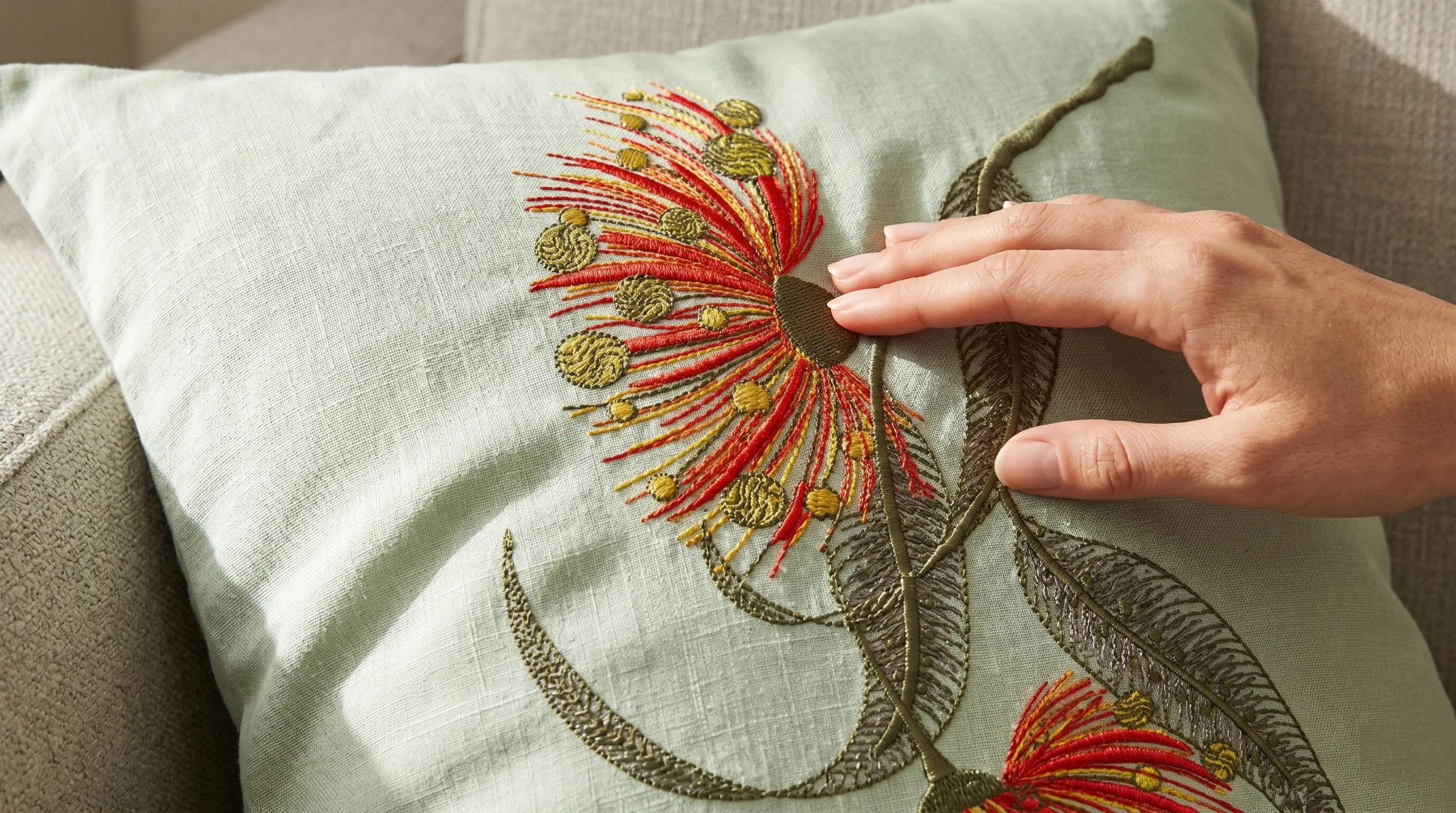
You reach out and touch it before you even think to. That's what good embroidery does to a room.
The eucalyptus blooms on this sage linen cushion are not printed. They are not appliquéd. They are stitched — red and coral thread radiating outward from each flower head like fireworks caught in slow motion, anchored by olive stems and grey-green leaves in dense satin stitch. The difference is tactile before it is visual.
You cannot help but want to touch it. And when you do, you understand immediately why embroidered home textiles have endured for centuries — and why they will endure for centuries more.
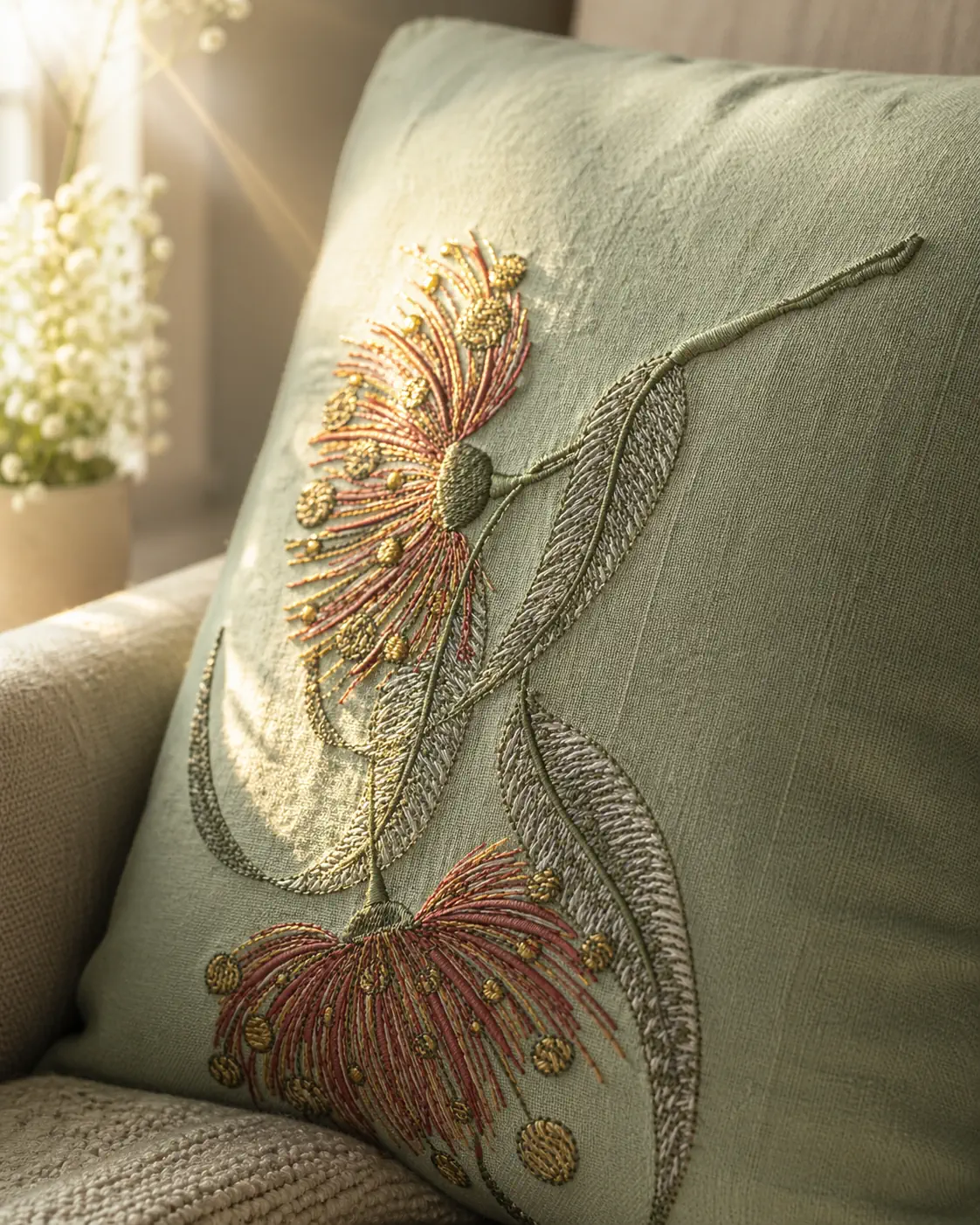
A printed cushion decorates a room. An embroidered cushion becomes part of it.
Why embroidery belongs in every room
Interior design has a texture problem. Modern interiors — clean lines, neutral palettes, minimal surfaces — are visually quiet by design. They ask for calm. But calm without warmth becomes cold. And warmth, in a room, almost always comes from something handmade.
An embroidered cushion solves this with precision. It introduces texture without clutter. Colour without pattern overwhelm. Craft without quaintness. The eucalyptus design shown here works in a Scandinavian-minimalist living room just as naturally as in a warm, layered Arts and Crafts interior — because the botanical motif is timeless and the palette is anchored by the sage linen ground.
This is what machine embroidery makes possible at home: botanically accurate, professionally executed textile art on a cushion you made yourself. Not a craft project. A design decision.
The eucalyptus flowering tree design is available as an instant-download embroidery file — tested on linen, perfectly scaled for a standard 50×50cm cushion cover.
The eucalyptus — why this motif works
Eucalyptus is not a gentle flower. Its blooms are explosive — dozens of stamens radiating outward from a central cap, creating a firework shape that has no equivalent in Western botanical tradition. It is simultaneously delicate and wild. Scientific and romantic. That tension is exactly what makes it so compelling as an embroidery subject.
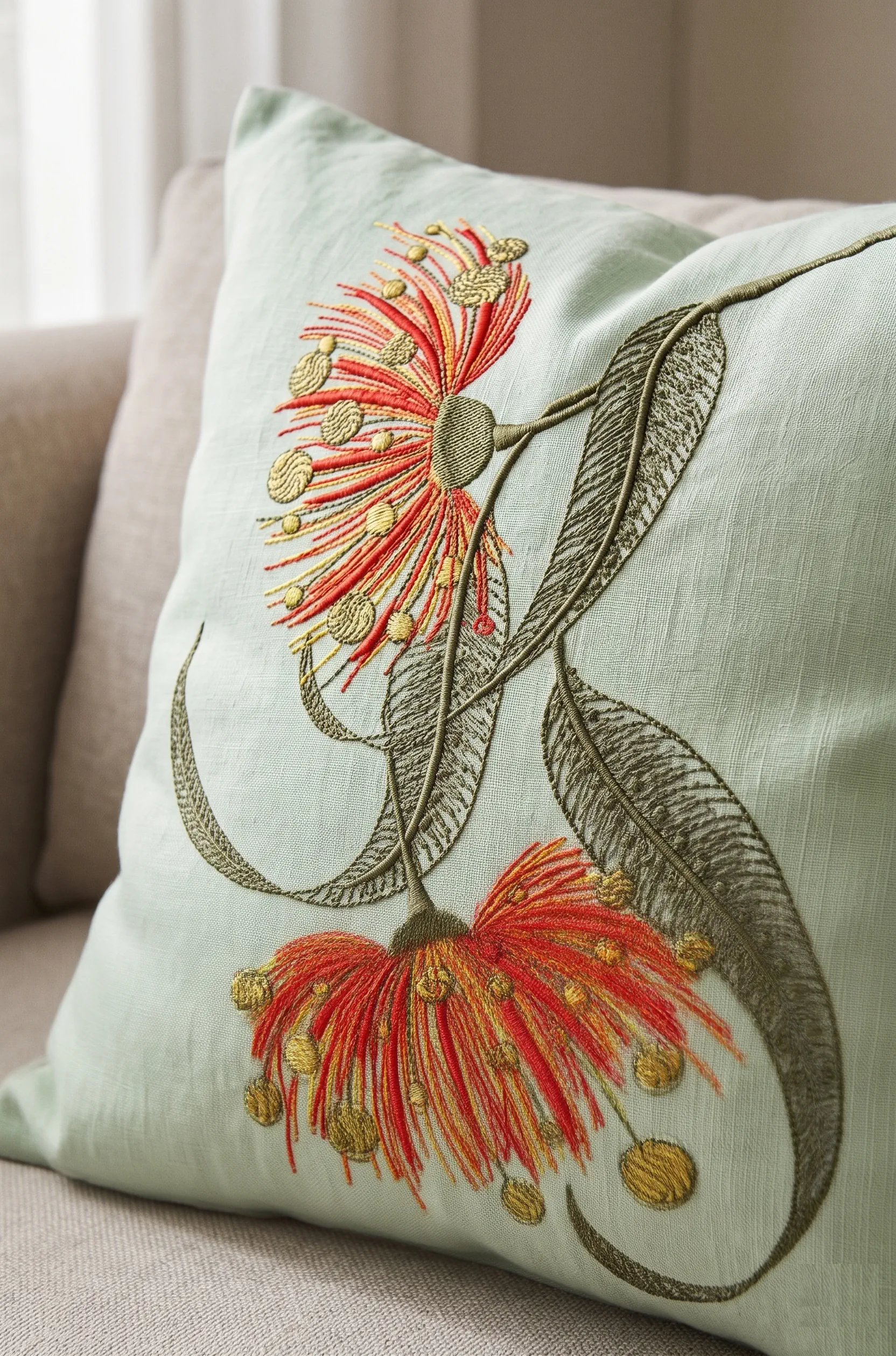
The design translates this perfectly. The flower heads are stitched in long radial threads — red shading to coral at the tips — with gold French-knot-style buds clustered at the base. The stems and leaves use a dense directional satin stitch in grey-olive that mimics the waxy, slightly metallic quality of real eucalyptus leaves. Every element earns its place.
On sage linen — the exact colour of fresh eucalyptus bark — the design becomes a painting. The cushion stops being soft furnishing and becomes the focal point of whatever surface it rests on.
Making the cushion — what you need to know
Medium-weight linen is the only correct choice
140–180 g/m² linen holds the design flat, supports the thread weight without distorting, and gives the finished cushion the relaxed, slightly textural look that makes embroidery sing. Sage green linen — as shown here — is available from most natural textile suppliers and is the exact colour this design was made for.
Cut-away — every time, no exceptions
A cushion cover is laundered. Tear-away stabilizer breaks down with washing. Cut-away stays permanently in place, invisible beneath the fabric, giving the dense satin-stitch areas of this design the support they need to stay flat and crisp through years of use. Trim to within 5mm of the design before constructing the cushion cover.
Rayon for the flowers, polyester for the stems
Rayon thread has a natural sheen that makes the coral and red flower heads glow against the sage linen — it catches light exactly as a real eucalyptus bloom does. Polyester in grey-olive for the stems and leaves gives durability to the areas that carry the most physical stress. The gold accents on the seed heads: rayon, 40wt, pulled tight.
Off-centre, never perfectly centred
Place the design slightly off-centre — the top bloom at the upper third of the cushion face, the lower bloom falling toward the lower-left corner. This asymmetry echoes how botanical illustration has always worked, and gives the cushion a composed, designed quality rather than the slightly rigid look of a centred embroidery.
The room is already ready. The cushion is what it's waiting for.
Interior design is not about adding things to a room. It's about finding the one thing that makes every other thing in the room make sense. For a neutral sofa on a neutral rug in a neutral room, that thing is almost always textile. And within textile, almost always embroidery.
The eucalyptus cushion shown here takes approximately 3–4 hours to stitch on a mid-range embroidery machine. The linen costs less than a scented candle. The thread costs less than a magazine. What you get is something that does not fade, does not date, does not accumulate with the season — and that becomes more beautiful as the linen softens with washing.
Embroidery that transforms spaces — with warmth, texture and timeless style. One cushion. One design. One afternoon.