
Machine Embroidery
in Modern Fashion Design
Why the world's most personal clothing trend isn't streetwear, isn't print — it's a needle, thread, and a design file downloaded in 30 seconds.
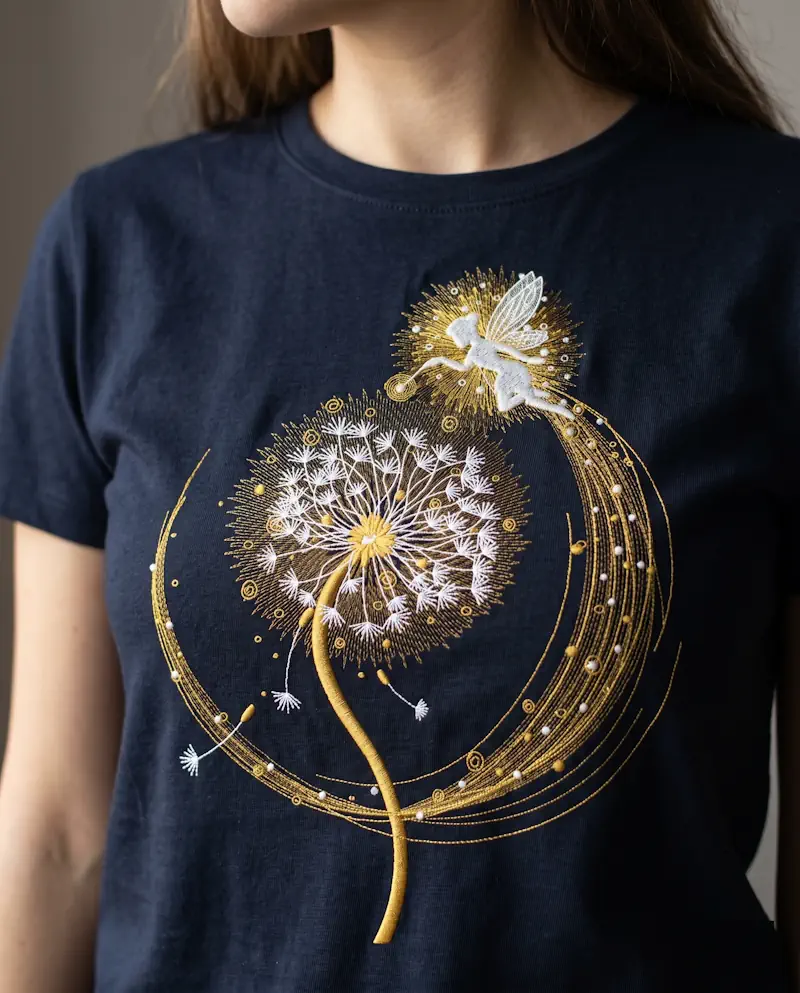
A plain navy t-shirt. A dandelion releasing seeds in gold thread. A fairy caught mid-flight in white and ivory. This is not print. This is not iron-on transfer. This is machine embroidery — and it has completely changed what personalised fashion means.
For decades, embroidery was associated with workwear logos and golf shirts. Today it's on runway collections, custom streetwear, bridal jackets, and limited-edition collaborations. The technology didn't change drastically — the designs did. And access to those designs changed everything.
Modern machine embroidery files let anyone — a small studio, a home sewer, a boutique brand — produce work that looks like it came from a couture atelier. The fairy dandelion you see here took under two hours to stitch. The design was downloaded in seconds.
|
$6.4B
Custom apparel market 2024
|
3x
Higher perceived value vs. print
|
72%
Consumers pay more for personalisation
|
30s
To download a professional design file
|
Why embroidery beats print — every time
It doesn't fade, crack or peel
Screen print fades after 30–50 washes. DTG print cracks. Embroidery done correctly looks identical after 200 washes as it did after the first. Thread is inherently more durable than ink on fabric. This is not a feature — it's a fundamental physical difference.
It has dimension and texture
Embroidery is three-dimensional. It catches light differently at different angles. Satin stitch glows. Running stitch whispers. A gold thread dandelion on navy cotton creates a visual depth that no print technology can replicate. It's the difference between a photograph and a sculpture.
It communicates craftsmanship instantly
People understand, instinctively, that embroidery takes skill and time. Even machine embroidery carries this association. A customer holding an embroidered garment handles it differently than a printed one — more carefully, more appreciatively. That emotional response translates directly into perceived value and willingness to pay.
It works on any fabric, any colour
White thread on black denim. Gold on navy. Ivory on cream linen. Embroidery doesn't care about substrate colour — thread covers the base entirely. Print on dark fabric requires expensive white underbase layers that add stiffness and cost. Embroidery simply stitches.
The personalisation revolution
The most valuable thing a brand can offer today is not a product. It's a product that couldn't exist for anyone else.
Machine embroidery makes true personalisation commercially viable for the first time. A name in script below a design. A date in the corner. A pet's silhouette replacing the standard motif. Each piece genuinely unique — at production speed.
The most requested personalisation globally. A first name in script, initials in a classic block font, a monogram framed by a botanical motif. Takes 4–8 minutes to stitch. Adds $15–40 to the retail price of the garment. Margin on personalisation is consistently the highest in apparel retail.
Wedding dates, birth dates, the GPS coordinates of a meaningful place. Small text elements added below a main design transform a beautiful garment into a story. Anniversary jackets, new-parent sweatshirts, graduation hoodies — these are gifted, kept and photographed.
A large chest design vs. a small left-chest logo vs. a sleeve motif vs. a back panel statement piece — the same design file, four completely different products. Placement is the simplest and most underused personalisation variable in apparel.
Where machine embroidery works in fashion — 6 real applications
01 — Statement T-shirts
The fairy dandelion above is the perfect example. A plain $12 blank becomes a $60–90 retail piece. Large chest embroidery on dark fabric is the fastest-growing segment in custom apparel. Intricate multi-colour designs — florals, celestial motifs, botanical illustrations — command premium prices because they look expensive. They are not expensive to produce.
02 — Caps and headwear
The classic entry point for embroidered fashion. Structured caps with 3D puff embroidery. Beanies with flat script logos. Bucket hats with all-over tonal embroidery. Cap embroidery is fast (8–12 minutes per piece), relatively simple technically, and carries enormous brand recognition value. Every major streetwear brand started here.
03 — Denim jackets & workwear
Back-panel embroidery on denim is the highest-value single placement in custom apparel. A large botanical, a dragon, a portrait — on a blank denim jacket it commands $150–300 retail. Workwear brands use chest-left logos for brand identity. Bridal parties use matching denim jackets with individual names.
04 — Luxury gifting & corporate merchandise
Companies ordering embroidered merchandise pay significantly more than for printed alternatives — and reorder more consistently. An embroidered polo with a company logo communicates status. An embroidered tote bag isn't thrown away. The gifting market for embroidered items grew 34% between 2021 and 2024.
05 — Patches and badges
The most versatile format in embroidered fashion. A design embroidered on felt or twill, cut out, sold or applied separately. Patches allow customers to customise existing garments. Limited-edition patch drops are a proven community-building tool for fashion brands. Patch packs retail at $8–15 each with production costs under $2.
06 — Kidswear & baby collections
Parents spend more on personalised children's items than any other demographic. An embroidered name on a baby onesie, a character on a toddler sweatshirt, a birth date on a blanket — these items are kept for decades. The emotional value is incalculable. The production cost is 4–6 minutes of machine time.
The business case — why this is genuinely profitable
| Item | Blank cost | Embroidery cost | Retail price | Margin |
|---|---|---|---|---|
| Statement T-shirt | $8–14 | $4–8 | $55–90 | 70–80% |
| Structured cap | $5–9 | $2–5 | $35–55 | 75–82% |
| Denim jacket (back panel) | $25–45 | $8–18 | $150–280 | 72–78% |
| Embroidered patch | $0.30–0.60 | $1–2 | $8–15 | 80–85% |
| Personalised baby onesie | $4–7 | $2–4 | $30–50 | 75–80% |
The most successful custom apparel businesses are not competing on price. They're competing on design. And the design is a file — downloaded once, used forever.
— Style & Shirt · Embroideres Design StudioWhat you actually need to start
An entry-level single-needle machine (Brother SE2000, Janome MC500E) handles 95% of fashion embroidery. For production volume, a multi-needle machine eliminates colour change time entirely. You do not need a $10,000 commercial machine to produce sellable work.
This is the single most important factor in the quality of your output. A professionally digitized design file contains every instruction the machine needs — stitch direction, density, sequence, underlay. A bad file produces bad embroidery regardless of machine quality. A great file makes an entry-level machine look professional.
Cut-away for knits and stretch fabrics. Tear-away for woven and stable fabrics. Topping (water-soluble) for fleece and textured surfaces. Matching the stabilizer to the fabric is the most commonly skipped step by beginners — and the most visible mistake in the finished piece.
Professional embroidery design libraries offer thousands of files tested across multiple machines and fabric types. The fairy dandelion above is exactly this — a studio-quality, multi-colour design that downloads in 30 seconds and stitches beautifully the first time.